Y.S. Stephen - Reader | Casual Observer
I read a lot, write a bit, ...occasionally play at illustration
Tuesday, 20 September 2016
Monday, 22 August 2016
The Demonic Bible School For Demons - Lesson X
A webcomic on why prayer is relatively low on the scale of spiritual difficulty and why we ought to stive to do the right things.
Labels: Demonic Bible School, God, Illustration, Spirituality, Webcomics
Thursday, 18 August 2016
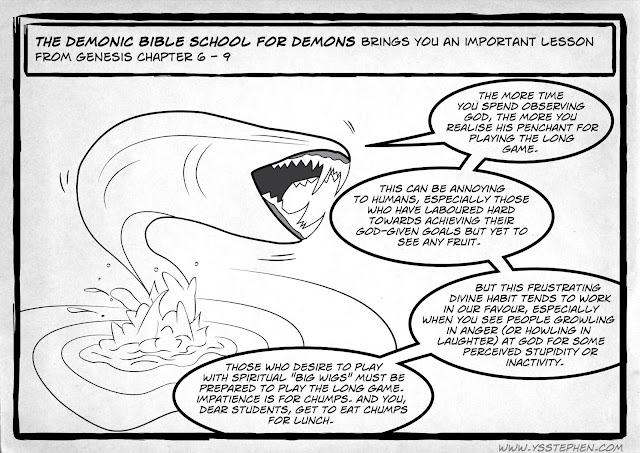
The Demonic Bible School For Demons - Lesson IX
A webcomic about God's preference of light over darkness.
Labels: Christian, Demonic Bible School, God, Illustration, Spirituality, Webcomics
Thursday, 11 August 2016
Thursday, 4 August 2016
Tuesday, 26 July 2016
Thursday, 7 July 2016
Thursday, 30 June 2016
3 Lessons From The Trials Of Job
There are many joyous events in the bible.
There are loads of suffering too. A lot. The book of Job highlights a unique example of suffering. I call it unique because, unlike many biblical examples, it shows a three-dimensional view of Job's plight.
Firstly, we have a divine background to the events that transpired, which was the conversation between God and the Accuser.
Secondly, it shows us the reactions of Job's family and friends - people close to him.
Thirdly, we get to know what Job thinks.
If there is anything to take away from these three different views, it is that:
1. GOD IS OMNIPOTENT - HE DOES WHAT HE WILL. However, we can take comfort that everything He does is for His glory and our eternal joy (if Job' story is anything to go by). Also, we can learn that the end of a thing is better than its beginning. Job suffered, but God recompensed him in ways he never thought was possible.
2. EVEN THE BEST THEOLOGY CANNOT CAPTURE GOD'S INTENTIONS. Job's friends were right in saying God punishes the wicked, but rewards the righteous. They were echoing what God's word, what He Himself had said (Isaiah 13:11; Proverbs 11:21). However, we know that this theology was inaccurate in Job's case - he was not a wicked man and he did nothing wrong; yet he suffered. This teaches us that compassion and mercy are key in dealing with suffering, whatever our perspectives about the situation. Just like Job's friends, judgmental attitudes won't help us, neither will it help the sufferer.
3. OUR RIGHTEOUSNESS IS OF LITTLE OR NO CONSEQUENCE TO GOD. Though Job bragged about his own goodness, the response God gave him was less-than-flattering. Thinking we are more than we are worth (even if we are right), is not really smart when it comes to transacting with the Creator. We are better seeking his grace and pleading for His favour. It this sounds a bit demeaning, it's not; for without Him, we are nothing.
Whatever fears are, whatever we are striving with, we must endeavour to nurture a bit of hope (Romans 5:4) based on the knowledge that nothing lasts forever (Ecclesiastes 3:1), and that God is working actively for our good, even when we have no clue about why we are going through so much pain.
May the peace of God be with you.
Labels: Christian, essay, God, Illustration, Spirituality
Thursday, 23 June 2016
Thursday, 16 June 2016
Thursday, 9 June 2016
Tuesday, 7 June 2016
Friday, 3 June 2016
The Benefit Of Poverty
You can discern the true nature of anything under the sun by observing what it permits and what it doesn't. For example, you can judge a social club by the members it solicits. You can perceive the true nature of a country by what it condemns and punishes; you can also discern its soul by what it lets go. Even precious metals accept some elements into themselves and reject others. Hence, when Jesus said it is easier for a camel to go through the eye of a needle than for a rich person to enter the Kingdom of God, He reveals the nature of the kingdom as well as the quality that diminishes one’s chances of taking hold of it.
Being rich (having loads of money) is an amazing state of being. Except you are a kid, I don’t need to explain what kind of experiences are at your disposal if you are rich man or woman. Having a lot of money removes a lot of this life’s obstacles and restrictions. In short, you have the power to do and achieve more.
Most people envy the rich, but having excess money has its set of burdens - some of which are considerable and wearisome. In his book, David and Goliath, Malcolm Gladwell highlights one of the unique difficulties of being rich, especially in the area of parenting. Gladwell believes it is easier for the poor to parent a normal and well-adjusted child than the rich. For example, if an 18-year-old son of a poor person asks his parents for a Toyota Prius, it is a bit easier to dissuade the kid from such wild fantasy, especially if the parents are sharing one decrepit car between each other. On the other hand, it is more difficult for a rich parent to say no, particularly if there is a Bentley or two outside the porch.
In terms of parenting, wealth contains a tiny seed of destruction in that it has the potential to lull the rich into settling for a convenient and conflict-free zone at a cost they are willing to pay for. And since future costs are unquantifiable and sometimes non-existent, such get deferred until a later date.
On the other hand, circumstances force the poor to live on the edge of combustible realities. Every incident matters - a tiny decision can plunge them into the abyss of further hardship and it can also bring a tiny stroke of fortune that lasts for a little while. Being poor can sometimes be like playing an RPG game where you have to live on a single round of consumable life compared to those with an excess of five lives or more. As a result, you tend to agonise over every choice at every turn because the consequences are considerable.
Because the poor walk this fine line, every penny is literarily earned. Every advantage that comes their way falls by the application of hard graft and labour. For these reasons, it is easier for the poor to be hyped up about little favours that come with less work. The destitute are more like to be thankful for tiny blessings and see them as chances to cool off - a respite from constant exertion of energy. And when the poor fail and fall into the abyss, their feelings can sometimes be much of resignation bordering on indifference. Because they live on the edge of despair and hardship, they tend to consider little problems as irrelevant.
The rich, on the other hand, have several cushions that nudge them away from the abyss. They possess many sanctuaries that protect them from the sharp jaws of most calamities. The light of their wealth can sometimes shine so brightly that it obscures them from seeing the darkness and myriad of spiritual influences roaming around.
Since humans are sensitive to the material and the rich have many of their materials met, it tends to blocks out any other influences outside of that bubble. This is why it tends to surprise the world (as well as the wealthy themselves) when an exceedingly rich person falls off the edge into the abyss. And compared to the poor, most wealthy people’s level of acceptance and composure in a fallen state is pretty low.
Mortification of the flesh, whether we admit it or not, is fairly easier for the poor than the wealthy. A rich person has easy access to many of the world's baggage in his grasp and can sometimes have difficulty letting go. But the destitute doesn’t have to contend with that kind of problem.
It is worth keeping in mind that because it is easy for the poor to let go doesn't necessarily reflects a great strength of will or spirit, but more like circumstances make it easier for them to sometimes make spiritually good decisions. Or put in another way, circumstances made the decision for them.
All in all, I think there is no profit in having a rich person's mentality. It is better to have a poor man's mentality instead. My definition of a poor man’s mentality is that which recognises that what he or she owns isn't truly their own. Such mind recognises the futility of life and material possessions. It is not content with chasing job success at the expense of peace of mind, family and the well-being of the soul.
Having a poor man's mentality doesn't mean you aren't generous to people, for generosity has little to do with how much or how little you have. Generosity is dependent on empathy and how much attachment you have to what you own.
A person with lots of money can always cultivate a poor man's mentality by developing empathy, appreciation and refusing to derive a sense of worth from their financial status. This is always a good place to start.
Labels: God, Spirituality
Thursday, 28 April 2016
Nothing Lasts Forever; Pain Especially
The presence of pain focuses our minds on the present. The now.
Things are a little different with happiness, though. Happiness can make you focused and present, but it makes time run like a hamster on coffee.
Pain, instead, reduces time to a standstill. It makes us think whatever we are feeling or whatever sad situation is happening to us at the moment is all there is. Prolonged emotional pain is like a nightmare where you are shouting, kicking, struggling - all in the bid to wake up and escape your nemesis - but nothing is working.
Ecclesiastes 1:4-10 echoes the theme that nothing lasts forever. This is a true constant. The problems of today always become the tales of tomorrow, if we still have our lives (one more reason to be thankful for our breaths). Lost loved ones, lost jobs, lost fortunes, marital problems, ill health, etc... will all be stories of the past - stories that'll end up on a good note if we persevere and try not to get swallowed up by the intense pain in our lives.
So my plea is for us to hang in there. By "hanging in there", I mean we should labour to take our eyes of our pain. Even when it gets dragged back, let's take it off again. It would surely get dragged back again, but we must not get tired of taking our eyes off it.
How do we take our eyes off? Well, I do that by reading, taking walks, staring at sunrises, gawking at sunsets, watching comedy shows (and cartoons), drawing, writing, listening to music and podcasts, gaming, etc. Yours may be different from mine, but we all have ways of taking our minds off things. I do not recommend drinking (I mean alcohol, c'mon), trolling, self-mutilation, shopping (burning through your bank account will lighten your wallet, but not your heart), and similar activities.
Those with spiritual leanings have an advantage of seeking a spiritual angle to their situation and trusting God to make relevant lessons apparent as well as making things right in His time.
So, yes... let's try and hang in there, okay?
** Photo used is "Pain" by Lien C. Lau and made available under a CC BY 2.0 license
Thursday, 31 March 2016
The Benefits Of Seeking To Trust The Lord More, Rather Than Obssessing Over Intellectual Correctness
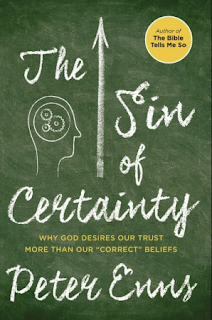
In this day where we have bibles of many translations, study bibles under different themes, regular Sunday schools as well as debates and numerous resources in many formats, the author of The Sin of Certainty, Peter Enns, wonders if our obsession with an intellectual-based faith isn't blocking us from progressing as a Church and as individuals. The evangelical scholar believes our frantic quest for intellectual correctness has led us far too deep into wrong roads, resulting in wrong priorities and divisions within the church. He writes:
When holding to correct thinking becomes the center, we have shrunk faith in God to an intellectual exercise, a human enterprise, where differences need to be settled through debate first before faith can get off the ground.Peter Enns talks about over-investment in intellectual engagement and the ineffectual nature of the arguments in spiritual matters. He says that debates over petty doctrines have a poor record of changing people's mind. He writes:
Few if any truly come to faith in God by the sheer force of an argument. We come to faith for all sorts of reasons that aren’t really “reasons” at all in the conventional sense. Our “reasons” are intuitive more than rational, emotional more than logical, mysterious more than known. I would say that coming to faith involves sensing God’s presence, which may transcend or even defy our ability to rationally process the encounter.The bible stories we read has stories of people like us, but who chose to invest their times in relationships with God as well as other beings around them. Their stories do not feature just moments of strengths but weaknesses as well. It is also worth noting that though a lot of these biblical characters were disappointed by God's actions in the world, they still chose to trust and continue their relationship with Him. Peter Enns illuminates this point, writing:
People in biblical times, after all, simply didn’t have the same preoccupation with what to believe as modern people do. For us, any religion, including Christianity, faces intellectual challenges that weren’t on anyone’s radar screens a few millennia ago.Trusting God and building up a relationship with Him remains our top priority, regardless of our head knowledge. When things get hard and uncertainty covers our world like a fog, it is our relationship with God, not head knowledge, that will see us through. Peter Enns echoes this by writing:
Believe in the original Hebrew is ‘aman (ah-MAHN), which has made its way into English, and we all know it as amen—only, it’s not a social cue that we’re done praying, and it’s okay to open our eyes and dig in. Amen as the final word of a prayer is a declaration of trust: “We’re done talking now, Lord. We’ve said our peace and put this matter into your hands. Now we trust you with it.”
Trusting God with all our hearts is a complete surrender, a life decision to be all in all the time rather than relying on our own “insight,” our ability to understand, to fathom, to solve, to figure out. Trust remains when our reason betrays us, when we don’t understand the mysteries of God and faith, when we don’t see what God is up to—including when God for all intents and purposes is not faithful or trustworthy.The Sin of Certainty by Peter Enns is an honest attempt to make sense of the way forward for Christians in the modern world. It is a book that tries to rediscover what chasing after God is all about in these days of non-belief. The book tries to nudge us away from extreme intellectual reaction-ism to the world around us. Most importantly, its tones encourage us to go back to what being a Christian is all about - a follower of Christ.
Many thanks to HarperOne for review copy.
Labels: Book Recommendation, Book Summary, Christian, Church, essay, God, Idea Mining
Thursday, 24 March 2016
The God Who Gambles
it is true that men are great at creation and manipulation. God, alas, is on another level. ...
I have been feeling a longing to move house of late. I have taken
We all have our illusions of freedom, a faith in our capacity to do what we want at any time we want with
Whenever we move our life's chess pieces around on our side of the board, there is always another movement, not only on the other side of the board but on our own side as well. Which means as we manoeuvre our life situations, other hand moves another piece simultaneously in our lives as well. You may see this as some kind of
Man thinks his ability to run around and manipulate situations puts him at the apex of this world. This is technically true. Atheists and humanists are right. Humans are on a
So it is true that men are great at creation and manipulation. God, alas, is on another level.
The book of Job shows God in one of His most carefree mood, showing the ability to switch things up at a whim and the audacity to back it up in the face of criticism. Despite my description, the book of Job can't be described as comforting. In the hard light of facts, it reveals a God who loves a gamble, using the lives of people at His disposal as chips while hedging his bets. Still, it shows a side of the God that is sovereign. Yes, that is the word. Sovereign. This "sovereign" tendency is not a quality that is the most pleasant to deal with. This is because this aspect of God operates outside of all influences, on earth and in heaven.
I aim to take a cursory look at the book of Job in the forthcoming months, at least for the rest of this year. My posts on this will be a bit sporadic (at least once a month). I aim to try, by God's help, to pick out little pockets of patterns that exist under this "sovereign" mannerism. But that is not all. The Job's interaction with people and God during his unfortunate calamity is also of interest to me. I hope to learn one or two things from it by using this book as a template. So yeah, let's see what we've got here.
** Photo used is "Creation" by
Labels: Christian, essay, God, Spirituality
Tuesday, 8 March 2016
The Sacred & The Mundane
Life can be ordinary, with enough routine to make you think you are on some kind of autopilot with no will of your own. You wake up, go to work, return home, eat, drink, participate in whatever hobbies or pastime you love (if you are lucky to have one), then kick your legs off to sleep. This is the way of the modern adult, and not many life situations jolt us out of that mould.
It is also the reason why we idolise those who seem to live outside of this bubble, especially those who, in Christian definition, are spiritual and dedicate more of their time to what we consider as “the things of God”. That can include praying, worship, preaching and the likes. It is why there is usually an air of veneration among Christians when someone with the common title of “Pastor” shows up.
We venerate and respect these kinds of people because, compared to our humdrum lives, where nothing seemingly spiritual exists but anger, stress, worry, depression and frequent illnesses, the "Pastor" seems to live a more holy life. In short, he or she is doing stuff we would like to do if we had more time or desire. This is one of the reasons we ask them to pray on our behalf, why we give gifts and why we honour them. In a warped way, they are an extension of our worship, because we believe if we treat them well, God might look on us favourably or the “man of God” might even put in a good word for us.
But what lifestyle qualifies as holy or unholy in God's eyes? Are we highly favoured because we spend more time on our knees? Or because we can sing for many hours on end? Are God's blessings for those prolific and gifted in dishing out insights from the Bible? Or are they for those on faraway missions, helping the needy in remote parts of the world? Are these activities "holy" enough to make us superstars, the elite of God's kingdom?
What about those who are busy with life? What the people with ashen faces in the mornings and ghostly visage at night, juggling three, four jobs at once? How high is their chance of doing something "holy"? Is it okay if they sneak out little pockets of time to moan towards the heavens about their circumstances? Is it acceptable for them to steal moments to speak to Him while they wait in long holdups, queues, or in the dead silence of bathroom breaks? Can they find Him when they sit down at work with Excel spreadsheets and MSWord staring back at them? Can they hold a brief conversation while they gaze into the eyes of sleeping loved ones? Is it enough for them to burst out in songs at the sight of the blind, the homeless, the mentally-ill in sorrow, gratitude or praise? Or is it acceptable to bow in reverence at the sight of the rising sun or the beauty of newly-hatched chicks running across their paths? Are tears of resignation or reverence at the sight of the suffering and the dying enough? Is this enough to gain God's ear, His smile, and have Him nod their way? For all we need, sometimes, is just a nod, an acknowledgement that our souls have a connection unseen, unheard and deep beyond the gaze of mortals to where all life originates - a connection to peace… and purpose. Sometimes that is all we need. All we need.
** Photo used is "Observe" by Hernán Piñera and made available under a CC BY-ND 2.0 license
Saturday, 13 February 2016
The Two Sides Of Faith
There is the faith that raised up the dead. The faith that opened up a closed womb. The faith that opened the sight of the blind. The faith that recovered what was lost.
On the other hand, there is the faith that did not raise up the dead. The faith that did not open a closed womb. The faith that was powerless against the onslaught of evil. And the faith that got your butt kicked all over the place.
Both faiths are one and the same.
For many generations, we have heard about the miraculous things done by faith. In the process, we have drowned out the voice of other credible witnesses who tell us the other side of faith - the shells of broken promises and husks of unfulfilled hopes - the ironical signs of a covenant on its way to fulfillment.
The triumphant side of faith brings lots of benefits to its teachers...
- Hebrews 11:39
** Photo used is "Urban Sadness" by
Friday, 8 January 2016
Friday, 18 September 2015
3 Erroneous Perspectives On Old Age
The Spirituality of Age takes a different view about growing older.
Read more »
Labels: Book Recommendation, Book Summary, essay, God, Idea Mining, Philosophy