Tuesday, 25 January 2022

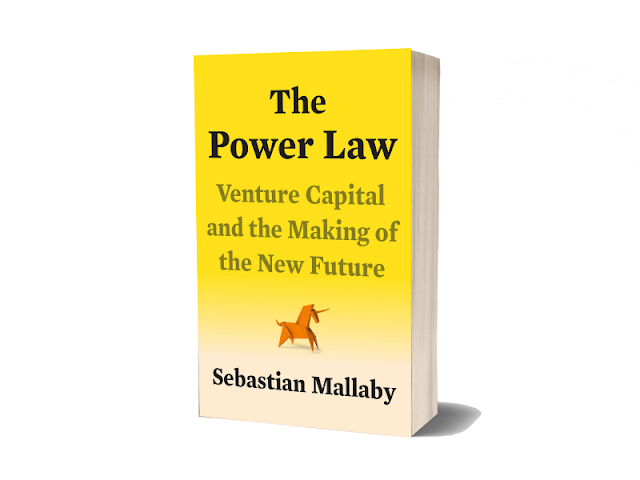
The Power Law: Venture Capital and the Making of the New Future by Sebastian Mallaby - Book Recommendation

The Power Law Venture Capital and the Making of the New Future by Sebastian Mallaby

Power Law is a recollection as well as observation of how venture capital works, its impact on the modern economy, and the psychology of the people who have made a success of it. This is a book that tells us stories about how a lot of the most successful companies today got their start and the profile of those who funded them.

WHAT I LIKE ABOUT POWER LAW
A lot of Power Law's contents contain quotes and interviews from the power players themselves - the venture capitalists - thus we are not relying on hearsay or third-party quotes.

I also love the background stories and the improbabilities of some of the encounters. They add a conspiratorial flavour to the book.

DISLIKES
This isn't necessarily a criticism but I felt the book was a bit too long. Still, it was a good read.

WHO IS POWER LAW FOR
Anyone with interest in investment, whether it is in form of venture capital, stock trading, ETFs, or otherwise will love the insights Power Law has to offer.

Many thanks to Penguin Press for providing a review copy.

Labels: ,

How To Profit From Bitcoins After 2021 by Minerva Singh - Book Recommendation

How To Profit From Bitcoins After 2021

How To Profit From Bitcoins After 2021 is an introductory text to Bitcoin - its history, nature, and how to profit from it. This is a book for beginners. It delves into the early days of Bitcoins, its mechanics, how it is mined, why it has become popular, and how to make money investing in it and other similar cryptocurrencies.

WHAT I LIKE
If you dislike technical jargon and heady financial phrases, then this is the book for you. It is one of the simplest and straight-to-the-point manuals I have ever read on cryptocurrencies. Reading the whole book would give you a solid foundation on cryptos and how to start making money from them.

DISLIKES
None.

WHO IS IT FOR?
How To Profit From Bitcoins After 2021 is for those who want to understand cryptocurrency and probably would like to invest in it.

Many thanks to BooksGoSocial for providing a review copy.

Monday, 24 January 2022

Living On Your Own Terms: The Odyssey Of Björn Natthiko Lindeblad


We all have our fears... scenarios where everything goes wrong and we are hanging out on an electric pole, metaphorically naked with the whole world jeering and seeing us for who we are. Sorry... that image might not be yours but you get the idea. While most of us are sometimes paralysed by these mental images, some do manage to transverse these dark alleys of the mind, shutting off doubts and following their own positive promptings to its conclusions. Lindeblad seems to be in this latter category. 

I May Be Wrong is a book that chronicles Lindeblad's journey and how he found himself in a forest monastery in Thailand after leaving a promising career.The author tells us what drove him to a monastery, what he learned on his journey, and what impact these strange decisions have made on his life. 

Living Free
WHAT I LOVE ABOUT THIS BOOK
I May Be Wrong is a book that tries to avoid the clichés of a well-to-do young white man trying to find himself in a third-world country. The account here is honest, self-deprecating, and eye-opening as to the condition of the human mind regardless of where you live in the world.

WHO IS THE BOOK FOR? 
This should be ideal for anyone seeking their own place in this world. This is a book that offers insight into human nature, our innate restlessness to assert ourselves in this world, and a way of finding a sliver of peace in the midst of it all. 

Many thanks to Bloomsbury Publishing for providing a review copy.


Labels: ,

Tuesday, 18 January 2022

5 Lessons From Erasmus' "Praise Of Folly"

In Praise of Folly by Erasmus

Desiderius Erasmus wrote In Praise of Folly in 1509 as a Christian satire that pokes fun at everyone, especially ridiculing those who take life too seriously.

In the book, Erasmus presents Folly (idiocy or foolishness) as a god who dishes out admonitions, criticisms, and other observations of humans. Most of the lessons in the book are timeless and would benefit most of us today. Here are a few I've found:

THE BEST OF HUMANS IS AS SIMPLE AS A CHILD
Folly claims she loves children because they take nothing seriously, hence, the weight of this world does not stick to them. She observes that most people want to play with children because their joy is infectious.

BE WHAT YOU ARE
Folly dismisses philosophers and priests with stern faces and other superficial layers which cover up who they really are. According to Folly, all these trappings contribute to personal suffering and, in the long run, take humans far away from joy.

FRIENDSHIP
Folly says she is essential to long-last friendships because she is the reason some people are able to overlook occasional slights. She explains that fools, by nature, find it difficult to hold on to grudges because it interferes with their happiness.

FUN AND FESTIVITIES
Folly says wisdom is a buzzkill at parties because no one can really have fun without allowing themselves to be silly and forgetful. Also, women are more fools than men, which is why festivities are much fun with them around. Folly believes the ability to let go and enjoy the moment is what makes women possess more common sense than men and hence, better off in terms of quality of life.

SELF CONFIDENCE
Folly believes that at the centre of many words is a lack of confidence. She thinks people's desire to find the 'truth' in everything points to some sort of anxiety about life and a lack of direction. Folly declares that fools do not take on such burdens as they love themselves fully.

In Praise of Folly sold lots of copies and was translated into many languages. Its popularity astounded Erasmus so much that he partly regretted its publication. Pope Leo X found the book amusing, but his successor was not happy with it and thus banned the book for many years.

In Praise of Folly is one of the few books from the 1500s that still enjoys modest popularity today. It is a work in a long tradition of religious satire that seeks to entertain, chastise, and educate - a rarity, by today's standards.


Labels: , ,

Tuesday, 11 January 2022

On The Intricacies Of Living With Monsters


We all have that voice that nags us when we do something inappropriate like making a cutting remark to someone when we don't mean it or overreacting to something so small that we end up making an okay situation worse. For some, this nagging voice can go on for minutes, for others... days, even weeks.

MonsterMind is a graphic novel that opens our eyes to how this process plays out in Alfonso Casas (the author). By using himself as an example, the author informs us of how he interacts with his inner monsters without losing himself. This is an autobiographical book that explores the debilitating thoughts that goes on in the author's head and how he sometimes succumbs or copes with it.

One of the strengths of great literature is how it holds up a mirror to see ourselves clearly. MonsterMind achieves this by making me identify with the author and his experiences. More importantly, I gain new perspectives and tools to live with my own inner monsters. As far as mental health books go, this has to be one of my favourites.

If have ever had trouble getting out of bed at any time of the day, unmotivated, and weighted down by anxieties real or imagined, then MonsterMind is for you. This is a book for every adult and young adult dealing with life's ups and downs.

Many thanks to Ablaze for providing a review copy.

Labels: , ,

Thursday, 6 January 2022

5 Lessons From Josh Waitzkin's "Art Of Learning"

The Art Of Learnng By Josh Waitzkin

The Art Of Learning is a semi-autobiography about Josh Waitzkin, the former chess prodigy, and martial artist. The book contains the experiences he accumulated about efficient learning - how to pick up crucial learning skills that will deepen your knowledge of your craft, no matter what it is.

Most of Waitzkin's experiences stem from his time playing chess at the highest level, winning Tai Chi Push Hands championships around the world, and his observation of top competitors like himself. A lot of important life lessons reside in this book, a few of which are: 


POPULARITY CAN BE HARMFUL TO MASTERY

After Josh won a couple of prestigious chess competitions his father wrote a memoir titled Searching For Bobby Fischer: A Father’s Story of Love and Ambition (1988). A movie was released based on the memoir (same title) in 1993, drawing attention to the young Josh Waitzkin and his talents. The attention generated by the movie distracted young Josh from what mattered to him and his performance dipped. According to Josh, "After the movie came out I couldn’t go to a tournament without being surrounded by fans asking for autographs. Instead of focusing on chess positions, I was pulled into the image of myself as a celebrity. Since childhood I had treasured the sublime study of chess, the swim through ever-deepening layers of complexity. I could spend hours at a chessboard and stand up from the experience on fire with insight about chess, basketball, the ocean, psychology, love, art. The game was exhilarating and also spiritually calming. It centered me. Chess was my friend. Then, suddenly, the game became alien and disquieting.

"At a young age I came to know that there is something profoundly hollow about the nature of fame. I had spent my life devoted to artistic growth and was used to the sweaty-palmed sense of contentment one gets after many hours of intense reflection. This peaceful feeling had nothing to do with external adulation, and I yearned for a return to that innocent, fertile time. I missed just being a student of the game, but there was no escaping the spotlight. I found myself dreading chess, miserable before leaving for tournaments. I played without inspiration and was invited to appear on television shows. I smiled."

ALERTNESS IS PRICELESS

The ability to be aware of your own presence and immediate environment is valuable to high-level competitors. This level of attention fuels self-knowledge as well as the ability to learn from anyone and anything. According to the author, "Once a simple inhalation can trigger a state of tremendous alertness, our moment-to-moment awareness becomes blissful, like that of someone half-blind who puts on glasses for the first time. We see more as we walk down the street. The everyday becomes exquisitely beautiful. The notion of boredom becomes alien and absurd as we naturally soak in the lovely subtleties of the 'banal.' All experiences become richly intertwined by our new vision, and then new connections begin to emerge. Rainwater streaming on a city pavement will teach a pianist how to flow. A leaf gliding easily with the wind will teach a controller how to let go. A housecat will teach me how to move. All moments become each moment... Presence has taught me how to live."


BE ALL YOUR EMOTIONS

There is a common notion that anger, sadness, even tiredness are enemies of competition. However, Waitzkin believes these emotions are vital to performance and life if you do not shy away, bottle, or shut them up. He writes, "Once you are no longer swept away by your emotions and can sit with them even when under pressure, you will probably notice that certain states of mind inspire you more than others. For some it may be happiness, for others it may be fear. To each his own. Petrosian was very flexible. Miller, Hernandez, and Robinson worked well with anger. Kasparov and Jordan were intimidators: they inspired themselves by wilting opponents. Once you understand where you lie on this spectrum, the next step is to become self-sufficient by creating your own inspiring conditions."

Situations are never ideal and the world always comes up with unconducive scenarios that make us uncomfortable and distracted. Having said that, Waitzkin believes people who understand who they are will always create conditions that would allow them to survive or thrive. According to him, this is the key to rising beyond difficult circumstances and maintaining sanity where others might wilt or give up. He writes, "Most of us are a complicated mix of greys. We have areas of stability and others in which we are wobbly. In my experience the greatest of artists and competitors are masters of navigating their own psychologies, playing on their strengths, controlling the tone of battle so that it fits with their personalities."

The Art Of Learning is a frank dive into what makes a high-level competitor as well as how to acquire true self-knowledge which seems key to learning of different kinds. Highly recommended.

Labels: , ,