Friday, 27 May 2016

Review - Halo: The Escalation Library Edition

So yeah, Halo needs no introduction if you are a fan of role-playing games (RPG) or any other shooter games. The game mechanics and the strength of the story are the main backbones of this franchise. Halo is a masterpiece of a story and I was thrilled for the opportunity to read one of the recent instalments of the comic book - Halo: The Escalation Library Edition, which contains Halo: Initiation #1 - #3 and Halo: Escalation #1 - #12. These volumes, if I am correct, expand mostly on the state of the Halo universe events that occurred shortly before and after Halo 4 (the game). Also, it seems some of the volumes (Initiation, especially) go way back before the events of Halo 4.

In one of the Initiation volumes, we get to see how UNSC get to pick Spartans and the process they go through to become one. The writers show us how Sarah Palmer becomes a Spartan and the enhancements made to her body.

There is also a story about Ilsa Zane, a rogue UNSC Spartan who hijacks Infinity. Spartan Zane is unique in the sense that she fights without armour and her strength equals a modern Spartan wearing a full armour. Needless to say, the hijack attempt is foiled and we are given a little insight into what is wrong the Ilsa Zane project and how she went rogue.  Another volume showcases the peace meeting between the brutes and the Arbiter (remember him?) and how that descends into chaos because a Spartan informant named Vladimir Scruggs betrays the location.


The writers also put in some annotations in the volumes, which comprises of their thoughts on some of the processes they went through when penning the stories and drawing the art. They reminisce on the meetings they had and their ideas on individual characters, which altogether makes this collection a refreshing experience.

The art is consistent throughout. Sometimes it feels as if they drew them all the same day. It was professional. There is nothing unique about the art to make it standout, but it is not bad by any means. They are all of good quality.

Halo: The Escalation Library Edition has loads of action scenes, background stories and almost everything diehard fans of the franchise will love. I know it's a cliche, but I highly recommend it.

Many thanks to Dark Horse Books for review copy.

Labels: , , , ,

Thursday, 26 May 2016

How Children Can Help us Escape The Problem Of Overthinking

Obsessing over certainty and worrying about achieving 100% error-free output can foster overthinking. And overthinking, in turn, prevents us from taking real action, blindsiding us against seeing the obvious when making decisions. Escaping this erroneous pattern of thought and many more are the themes of Mathew E. May's book, Winning The Brain Game: Fixing The 7 Fatal Flaws Of Thinking.

When it comes to overthinking, Mathew E. May says, we have a lot to learn from children. He believes children rarely falls into this habit. Also, he believes the ways children solve day to day problems can help us escape the problem of overthinking. He writes:
I remember vividly my daughter as an infant in her high chair dropping food on the floor. She was a perfect little learner, wondering what would happen if she could somehow get her strained carrots on the floor. I’m certain that the problem was somehow framed quite clearly to her— how do I get them on the ground? —perhaps not in words, for she could not yet talk. Tracking her eye movements, I watched her consider several hypotheses: she could tip her entire bowl over the tray, she could fill her spoon and flick away, or simply grab a fistful and fling—three viable ways to answer the question. Now the fun begins. She decides quickly to try the bowl- tip method, and runs her test. Her success metric is obvious: food on the floor. Her test works wonderfully well. In fact, the feedback exceeds her expectations: the noise from her dish as it crashes on the tile gives her great glee, food is everywhere, and Mom gets really busy. Yay! So fun!! It works so well she adopts it as her tentative best practice. As Mom cleans up and replaces a full bowl of food on the tray, she does what any good scientist does, and confirms her results. This time, however, the feedback is a bit different, and not as positive as the initial trial: Mom isn’t happy about it, and Dad has to get involved. Lesson learned. So she launches another experiment, this time with the spoon method. Without any help or guidance, my daughter was learning just fine on her own, in the most powerful way: satisfying her natural curiosity through rapid experimentation. In this type of learning, the test came before the lesson. There was no sense of failure, for it was a concept yet to be introduced. Without a sense of failure, she was fearless in her learning and experimenting. It would not be long before it would disappear. Once in the classroom, her fearless learning through testing was replaced by a new kind of learning. Her teachers now asked the questions, and she had to answer correctly. the need to be certain and correct grew. In a complete reversal of her toddler learning, she faced a new kind of test, one that came after the lesson. There was a right and wrong answer involved with this kind of test, and a grade called 'F', for failure. Along with grades on tests came fear.

At the root of overthinking is fear. And with this fear comes the fixation of making fewer errors, thus reverting to easy patterns of thinking, focusing on what has worked before and reluctance to take risks. In the long run, this cripples creativity in individuals and foster timidity of thought in organisations.

Winning The Brain Game takes a comprehensive look at why we think the way we do and how to reset our brains to look at situations from a neutral point of view in place of lazy or biased perspectives.

Winning The Brain Game can be a bit difficult to read in parts. However, its real-life examples and illustrations help put its point across. If you don't like complex theories with long analogies, this might not be the book for you. But if you are willing to stick it out, the reward can be great. I recommend this book to those seeking change in the way they think about life and problems.

Many thanks to McGraw-Hill Education for review copy.

Labels: , , ,

Friday, 20 May 2016

Psalmic Feelings In Modern Mindsets (II)


Labels:

Wednesday, 18 May 2016

Cynicism Breeds Laziness

I think I'm becoming more cynical than I used to be - you know, life experiences and all. I have also noticed that with this cynicism comes apathy, the desire to scoff at anything without deliberating about what I could do to make it better.

Cynicism blocks light; it tries to erase smudges of hope about any situation by mocking it, or mocking those taking action on it. Cynicism also breeds laziness because it gives you excuses not to try anything because you've already given yourself an excuse that nothing is going to work.

I try to overcome my cynicism by opening myself to more hope. In concrete terms, I listen to people who are hopeful and doing something to make their situation better. I try and stop watching sad news (or any news, to be fair) on TV or the web. It is for the same reason I block people who post images of maimed or dead people on Facebook, asking me to pray that such things won't happen to me. I watch comedies, listen to funny stories. I try to laugh. That way, I'm able to psyche myself off my butt to do something, instead of complaining or just laughing about it.

Labels: ,

Monday, 16 May 2016

The Importance Of Telling Yourself Great Stories About Yourself

In this age of information, you must talk to yourself often so you won't go mad. 
Humans have always heard voices in their heads. Those voices, sometimes, can be helpful. Sometimes they can be unhelpful. The advent of internet information has made the echoes and the frequency of these voices louder than ever. As much as TV, magazines, emails, and Facebook posts, can be used for good things, the information they produce can also give affirmation to our worst fears or feed our narcissism. 

You may think your life sucks. But there are a lot of people who are in worse positions than you are. No one has a perfect life, even if they want you to think so. Hence, don't be drowned out by information. Neither should you believe everything you read.

Even if your old acquaintances or friends are leaving you in the dust and moving fast ahead in life, so what? As long as you don't navel-gaze all day, but work hard and trust in your Maker, you will turn out fine.

Don't let unhelpful voices stay in your head for too long. Talk to yourself often. Talk over the negative voices. Tell yourself you are smart, you are beautiful, you are cool, you are a hard-worker. And try and follow it up with relevant actions.

Time away from the screen isn't a bad idea, especially if you find its contents depressing. Read an interesting fiction. If that's not your thing, go for walks. You may even get yourself a funky album and dance if that is your preference. Who cares if people see you and snicker. Be happy. Life is short; too short for you not to tap into your awesomeness.

Labels: ,

Thursday, 12 May 2016

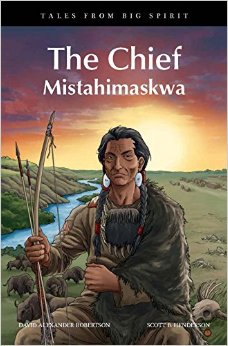
Tales from Big Spirit Series - The Chief Mistahimaskwa

 The Chief Mistahimaskwa
As the saying goes, to the victor goes the spoils and err... the stories. This has been the narrative of western civilisation. Our history books are distorted with fanciful tales of the victor, tales that magnifies their exploits and obscure their questionable deeds. There are not a lot of voices from the point of view of the vanquished. The few voices that exist are faint as they are being drowned out by the mainstream stories. However, seeing a graphic novel that tries to tell a tale from an alternative view is one of the reasons why I decided to pick up The Chief Mistahimaskwa, a middle-grade YA historical-based adventure story.

The Chief Mistahimaskwa is about Sarah,  a girl who gets sucked into a book and finds herself looking into the Saskatchewan Plains of 1832 where she sees the life of a young boy who is learning the ways of his people (the Cree) and would later become the chief. This story is based on what happened to the Cree during an era when the Europeans are taking over the native lands of the Cree, around the area that is now known as Canada.

What fascinates me about The Chief Mistahimaskwa is that though it is an historical-based fictional tale, it shows the sensibilities and perspectives of the Cree in a colourless tone.  The main spine of the tale is about Mistahimaskwa, who is also known as Big Bear, as he tries to helps his people survive and navigate the new world that is ushered in with the advent of the Europeans. The Chief leads his people through famine, diseases and is reported to be the last chief to sign a treaty with the Europeans. Though he meets with difficult opposition within and without, he tries to steer his people away from bloodshed that is inevitable as they try to fight with the invaders.

 The Chief Mistahimaskwa


 The Chief Mistahimaskwa

The Chief Mistahimaskwa is a delightful graphic novel with a straight-forward historically based tale on one of the main players of Cree during 1800s. The art is simple and the bright colours invite us into the story. The dialogue is great in parts and conveys enough charm for us to progress with the tale . This is a book reluctant reads can get into with ease. The language is direct while complex narratives and concepts are ditched for a simple tale that can be grasped by all and sundry.

Many thanks to Portage & Main Press for review copy.

Labels: , , , , ,

Tuesday, 10 May 2016

Psalmic Feelings In Modern Mindsets (I)


Labels: ,

Thursday, 5 May 2016

Krista Tippett Explains The Secret To Listening Well


Becoming Wise: An Inquiry into the Mystery and the Art of Living by Krista Tippet is a collection of her thoughts and experiences on five of what she calls the "raw materials" of the human life. The contents of the book are not composed of her insights alone, but also the perspectives of people who had made an impression her over the years.

One of the concepts she writes about is that of listening. As a master listener herself, she defines listening as an art. She writes:
Listening is an everyday social art, but it’s an art we have neglected and must learn anew. Listening is more than being quiet while the other person speaks until you can say what you have to say. I like the language Rachel Naomi Remen uses with young doctors to describe what they should practice: “generous listening.” Generous listening is powered by curiosity, a virtue we can invite and nurture in ourselves to render it instinctive. It involves a kind of vulnerability—a willingness to be surprised, to let go of assumptions and take in ambiguity. The listener wants to understand the humanity behind the words of the other, and patiently summons one’s own best self and one’s own best words and questions. Generous listening in fact yields better questions. It’s not true what they taught us in school; there is such a thing as a bad question. In American life, we trade mostly in answers—competing answers—and in questions that corner, incite, or entertain. In journalism we have a love affair with the “tough” question, which is often an assumption masked as an inquiry and looking for a fight.
For me listening without assumption is key. There is a tendency for us to tune out when hearing other people talk, especially if we think we know what they are going to say. This leads to a situation Krista describes where we wait with answers instead of actually listening to the person talking to us.


Becoming Wise is full of insights such as above. Almost every sentence and paragraph are crafted to help, to admonish, to and enlighten. Becoming Wise isn't a book to rush through. It is not a light read by any stretch of imagination. It is deep and possesses tangled paths that can lead the reader to delightful places of the mind and spirit. Becoming Wise is for anyone serious about living meaningfully and on their own terms. I believe Becoming Wise it is a treasure that would endure for a long time.

Many thanks to Penguin Press for review copy.

Labels: , , ,