Thursday, 31 March 2016

The Benefits Of Seeking To Trust The Lord More, Rather Than Obssessing Over Intellectual Correctness

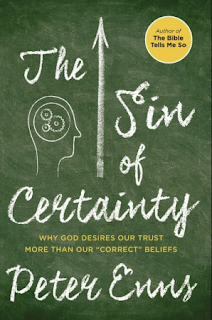
In this day where we have bibles of many translations, study bibles under different themes, regular Sunday schools as well as debates and numerous resources in many formats, the author of The Sin of Certainty, Peter Enns, wonders if our obsession with an intellectual-based faith isn't blocking us from progressing as a Church and as individuals. The evangelical scholar believes our frantic quest for intellectual correctness has led us far too deep into wrong roads, resulting in wrong priorities and divisions within the church. He writes:
When holding to correct thinking becomes the center, we have shrunk faith in God to an intellectual exercise, a human enterprise, where differences need to be settled through debate first before faith can get off the ground.
Peter Enns talks about over-investment in intellectual engagement and the ineffectual nature of the arguments in spiritual matters. He says that debates over petty doctrines have a poor record of changing people's mind. He writes:
Few if any truly come to faith in God by the sheer force of an argument. We come to faith for all sorts of reasons that aren’t really “reasons” at all in the conventional sense. Our “reasons” are intuitive more than rational, emotional more than logical, mysterious more than known. I would say that coming to faith involves sensing God’s presence, which may transcend or even defy our ability to rationally process the encounter.
The bible stories we read has stories of people like us, but who chose to invest their times in relationships with God as well as other beings around them. Their stories do not feature just moments of strengths but weaknesses as well. It is also worth noting that though a lot of these biblical characters were disappointed by God's actions in the world, they still chose to trust and continue their relationship with Him. Peter Enns illuminates this point, writing:
People in biblical times, after all, simply didn’t have the same preoccupation with what to believe as modern people do. For us, any religion, including Christianity, faces intellectual challenges that weren’t on anyone’s radar screens a few millennia ago.

Believe in the original Hebrew is ‘aman (ah-MAHN), which has made its way into English, and we all know it as amen—only, it’s not a social cue that we’re done praying, and it’s okay to open our eyes and dig in. Amen as the final word of a prayer is a declaration of trust: “We’re done talking now, Lord. We’ve said our peace and put this matter into your hands. Now we trust you with it.”
Trusting God and building up a relationship with Him remains our top priority, regardless of our head knowledge. When things get hard and uncertainty covers our world like a fog, it is our relationship with God, not head knowledge, that will see us through. Peter Enns echoes this by writing:
Trusting God with all our hearts is a complete surrender, a life decision to be all in all the time rather than relying on our own “insight,” our ability to understand, to fathom, to solve, to figure out. Trust remains when our reason betrays us, when we don’t understand the mysteries of God and faith, when we don’t see what God is up to—including when God for all intents and purposes is not faithful or trustworthy.
The Sin of Certainty by Peter Enns is an honest attempt to make sense of the way forward for Christians in the modern world. It is a book that tries to rediscover what chasing after God is all about in these days of non-belief. The book tries to nudge us away from extreme intellectual reaction-ism to the world around us. Most importantly, its tones encourage us to go back to what being a Christian is all about - a follower of Christ.

Many thanks to HarperOne for review copy.

Labels: , , , , , ,

Thursday, 24 March 2016

The God Who Gambles


...it is true that men are great at creation and manipulation. God, alas, is on another level.

I have been feeling a longing to move house of late. I have taken time to study the current world situation and that of my immediate environment. And my conclusion is always pretty much the same - the time to move is near. However, after much thought and I'll admit, a little prayer, I couldn't but feel a sense of déjà vu. I feel like I'm being mugged. Again.

We all have our illusions of freedom, a faith in our capacity to do what we want at any time we want with results that falls in line with our predictions. But the end game is always the same, isn't it? For many of us striving to make our lives more convenient, chasing riches, material wealth or whatever you may call it, all to improve our lot, we have noticed that more money doesn't change our inner circumstances. Being rich means you have more stuff, but if you are a paranoid person before you got rich, you stay paranoid. If you have the habit of lying before you became rich, that won't change. If you have a problem with pornography before, that definitely stays with you. Even self-help devotees know the pain of conquering a habit for another similar one to pop out and stick to you like a tick. Habits you thought you've conquered can rear its ugly head when you least suspect. This is the soap opera called life, where nothing is certain; a stage where you can count few things as foregone conclusions.

Whenever we move our life's chess pieces around on our side of the board, there is always another movement, not only on the other side of the board but on our own side as well. Which means as we manoeuvre our life situations, other hand moves another piece simultaneously in our lives as well. You may see this as some kind of double play, which isn't fair by most standards. But when it comes to things unseen, otherwise called "the spiritual" by spiritual people, that is how the game is played.

Man thinks his ability to run around and manipulate situations puts him at the apex of this world. This is technically true. Atheists and humanists are right. Humans are on a god level. We can create, change and manipulate. A quick look at what humans have achieved in the last hundred years testifies to this.  The best of us are good at planning, taking all variables into account and implementing actions. But when it matters most, the end results are not always up to us.

So it is true that men are great at creation and manipulation. God, alas, is on another level.


The book of Job shows God in one of His most carefree mood, showing the ability to switch things up at a whim and the audacity to back it up in the face of criticism. Despite my description, the book of Job can't be described as comforting. In the hard light of facts, it reveals a God who loves a gamble, using the lives of people at His disposal as chips while hedging his bets. Still, it shows a side of the God that is sovereign. Yes, that is the word. Sovereign. This "sovereign" tendency is not a quality that is the most pleasant to deal with. This is because this aspect of God operates outside of all influences, on earth and in heaven.

I aim to take a cursory look at the book of Job in the forthcoming months, at least for the rest of this year. My posts on this will be a bit sporadic (at least once a month). I aim to try, by God's help, to pick out little pockets of patterns that exist under this "sovereign" mannerism. But that is not all. The Job's interaction with people and God during his unfortunate calamity is also of interest to me. I hope to learn one or two things from it by using this book as a template. So yeah, let's see what we've got here.

** Photo used is "Creation" by raphaelstrada and made available under a CC BY-ND 2.0 license

Labels: , , ,

Thursday, 17 March 2016

Now Go Out There (And Get Curious) - Mary Karr's Commencement Address 2015

Like Pema Chodron, who told the graduating students of Naropa University in 2014 to get curious about their mistakes as mistakes can be a portal to creativity, so said Mary Karr in her 2015 commencement address to the graduating students of Syracuse University.

Mary Karr, the author of three award-winning, bestselling memoirs and the Peck Professor of Literature at Syracuse Univeristy, exhorts the graduating students to banish any fear of misfortune and face their lives with optimism. Like any good storyteller, the author dips into her past, telling the students her story of drugs, poverty and mental issues that almost drove her to give up on everything. However, she counsels that the darkest roads often hides the paths to redemption and people out to be curious about what scares them. She says: 
"And if you can get curious about what scares or infuriates you—especially if it’s part of yourself—you can grow less scared........ And stuff that first looked like the worst, most degrading thing that could ever happen almost always led me to something extraordinary and fine."

Moreover, she says that even when overcome by fear and hopelessness, we should use that to develop empathy towards those who feel as they do. As she says, "a great talent for fear could also mask a talent for empathy. For caring how others feel for tenderness."

HarperCollins has made this commencement address into a book titled Now Out There (And Get Curious) to be published in April 2016. Whether you are a student or an adult, Now Go Out There is a fine read and a collection of encouraging words from someone who has gone through hard times and triumphed.

Many thanks to HarperCollins for review copy.

Labels: , , ,

Thursday, 10 March 2016

Silence and Beauty by Makoto Fujimura

Makoto Fujimura's Silence and Beauty is a book worth reading more than once.

Silence and Beauty reads like a book review. After several pages, this assessment changes and you kind of start looking at it as a memoir of some sorts. Truly, Silence and Beauty is both review and memoir, but a remarkable trait of this book is the ease with which it navigates between the two identities.

Silence and Beauty is written by the award winning contemporary artist, Makoto Fujimura. The book is an exploration of another book titled Silence by Shusaku Endo. Silence is a historical fiction about a Jesuit priest who ventures into 17th century Japan to seek out his mentor who is rumoured to have turned into an apostate. The priest manages to enter Japan, but from his arrival notices the influences of an ongoing persecution that has led to the deaths of several local Christians.

The Japanese Christian persecution, which springs from a shogun's effort to wipe out Christianity from Japan, soon sweeps up the newly-arrived priest in its wake.  Even when the priest finds his old mentor, it was as an enemy working for the shogun. Amidst the calamity going on is Kichijiro, a local Christian and a drunk who denies his faith every time he is caught by Shogun's men. Kichijiro does much to harm his fellow christians, but he tries to find redemption by helping them in some ways too. Though the persecution claims many lives, Kichijiro finds a way to survive.

Silence and Beauty examines Shusaku Endo' s fiction (Silence) under the theme of suffering, God, and Japan. The book looks at the underlying interpretation of Silence on these issues as well as Shusaku Endo's personal life. It shines a light on the fallacy of the western narrative of triumphantlist faith - the one that overcomes, stood steadfast, and strong in the face of its enemies. Silence and Beauty talks about failed faith - the faith that crumbles under persecution, that hides the light of God under scrutiny and tries to survive and live on in extreme circumstances. The author writes:

We have a tendency to extol heroes of faith; our textbooks and our sermons are filled with the heroic. In doing so, we fall into a false dichotomy of seeing faith only in terms of victory or failure, which leads us to dismiss and discard the weak.

On the memoir side of things, the author of Silence and Beauty takes a look at his own Christian journey and finds similarities with Kichijiro. He also observes the modern Japaneses society, where Christianity is close to non-existence. He observes that the Japanese prevalent culture of silence as well as hiding individual thoughts and expressions is not an accident but a spill-over from their history of bloodshed and repression. However, he holds out a bit of hope for his country and prays that the sacrifices of the Christians of old will fire-up the change needed in Japan.

Silence and Beauty is altogether a fine read, though a bit dark-ish. This is a book with heavy shackles. Its emotionally heavy contents will slow you down as you plough through while ruminating on difficult but accurate observations of the Japanese mindset, faith, art and life. This is a book for those who love to think.


Many thanks to InterVarsity Press for review copy.

Labels: , , , , ,

Tuesday, 8 March 2016

The Sacred & The Mundane

https://www.flickr.com/photos/hernanpc/15888579414/

Life can be ordinary, with enough routine to make you think you are on some kind of autopilot with no will of your own. You wake up, go to work, return home, eat, drink, participate in whatever hobbies or pastime you love (if you are lucky to have one), then kick your legs off to sleep. This is the way of the modern adult, and not many life situations jolt us out of that mould.

It is also the reason why we idolise those who seem to live outside of this bubble, especially those who, in Christian definition, are spiritual and dedicate more of their time to what we consider as “the things of God”. That can include praying, worship, preaching and the likes. It is why there is usually an air of veneration among Christians when someone with the common title of “Pastor” shows up.

We venerate and respect these kinds of people because, compared to our humdrum lives, where nothing seemingly spiritual exists but anger, stress, worry, depression and frequent illnesses, the "Pastor" seems to live a more holy life. In short, he or she is doing stuff we would like to do if we had more time or desire. This is one of the reasons we ask them to pray on our behalf, why we give gifts and why we honour them. In a warped way, they are an extension of our worship, because we believe if we treat them well, God might look on us favourably or the “man of God” might even put in a good word for us.

But what lifestyle qualifies as holy or unholy in God's eyes? Are we highly favoured because we spend more time on our knees? Or because we can sing for many hours on end? Are God's blessings for those prolific and gifted in dishing out insights from the Bible? Or are they for those on faraway missions, helping the needy in remote parts of the world? Are these activities "holy" enough to make us superstars, the elite of God's kingdom?

What about those who are busy with life? What the people with ashen faces in the mornings and ghostly visage at night, juggling three, four jobs at once? How high is their chance of doing something "holy"? Is it okay if they sneak out little pockets of time to moan towards the heavens about their circumstances? Is it acceptable for them to steal moments to speak to Him while they wait in long holdups, queues, or in the dead silence of bathroom breaks? Can they find Him when they sit down at work with Excel spreadsheets and MSWord staring back at them? Can they hold a brief conversation while they gaze into the eyes of sleeping loved ones? Is it enough for them to burst out in songs at the sight of the blind, the homeless, the mentally-ill in sorrow, gratitude or praise? Or is it acceptable to bow in reverence at the sight of the rising sun or the beauty of newly-hatched chicks running across their paths? Are tears of resignation or reverence at the sight of the suffering and the dying enough? Is this enough to gain God's ear, His smile, and have Him nod their way? For all we need, sometimes, is just a nod, an acknowledgement that our souls have a connection unseen, unheard and deep beyond the gaze of mortals to where all life originates - a connection to peace… and purpose. Sometimes that is all we need. All we need.

** Photo used is "Observe" by Hernán Piñera and made available under a CC BY-ND 2.0 license


Labels: ,

Thursday, 3 March 2016

Flair: Design Your Daily Work, Products, and Services to Energize Your Customers, Colleagues, and Audiences


Flair, by Jim and Jennifer Poage, focuses on teaching us how to do work that excites the world. With real-life examples and anecdotes, the book tells us how to master the skill of rendering unforgetable services and creating products that stirs up positive emotions.

Using Dr Dre's Beats headphones, Reebok jerseys, The Magic Castle Hotel (Hollywood) as examples among others, Flair gives us a glimpse of what creators considers as the essence of their creation as well as what effective flair looks and feels like.

What is flair? How do we recognise it? The book states that effective flair must have some, if not all, of the following elements:
Story - Tell a story about your offering.
Entertainment - Have your offering entertain your customers.
Experience - Create pleasant, even happy, customer experience.
Sincerity - Construct flair to accurately reflect your offering.
Excellence - Be sure your offering is high quality so it doesn't disappoint.
Energy - Strive to energize your customers.

Flair, by Jim and Jennifer Poage, doesn't try to pretend it has "the secret formula" for creating the next great product or service. Rather it makes a clear disclaimer, saying that creating great products or services that resonates with people is a matter of taste; and what energises some people may be repulsive to some.

Also the book explains that creating flair isn't exactly a science (if it is, everyone would be doing it), but incorporating the above elements can take us closer to our goal.

Flair isn't too difficult to read. It is well-researched and the real-life examples given helps buttress the book's argument that flair can be learned. If you are looking to energise your work and raise your game, then this book might be a book for you.
 
Many thanks to Maven House for review copy.

Labels: , , , , ,

Tuesday, 1 March 2016

The Importance Of Keeping Spiritual Exercises In Perspective


I love reading and writing. I have benefited from practicing these disciplines and can attest to their powers. However, it would be naive of me to think reading or writing is an end in itself. We read (and, or write) to gain knowledge, we do it to expand our horizons, we do it to understand one another. We can also use it to incite hatred or spread malice. The point is: the act of reading or writing is a tool and its usefulness depends on the person wielding it, among other things.

I take a similar view with spiritual disciplines like fasting, bible reading, prayers, and the likes. I have heard many extolling the value of bible reading in ways that makes you think the book itself contains magical properties, while some treat the act of prayer like a magic wand that grants all dreams and wishes. Needless to say, these spiritual disciplines are believers' lifeblood and we cannot do without them. But just like writing and reading, they are tools and can be used rightly or wrongly. More importantly, these activities lack any spiritual power of their own. You can go on a fast and benefit physically, but divine profit comes not from the discipline but from God.

It's bad enough using prayers, fasting, and bible study for selfish reasons, but it is worse when doctrines like holiness, faith, and giftings are set aside from their Source and touted as concepts that possess innate power. And while we may plaster the walls of our homes with posters of words like "Prayer is the most powerful force in the world", "A scripture a day keeps the devil away," or "By fasting the body learns to obey the soul", what these phrases promote are distorted thinking about the purposes of spiritual tools as well as what they can do. 

Of course, no one ever comes out to say spiritual activities are more important or powerful than God. As a matter of fact, everyone says the opposite. But when someone starts prescribing prayers like Ibuprofen for you to use and vanquish your "problems", then that is a sign of misuse.

What is the lesson here? The lesson is God first, then His gifts or disciplines afterwards. Anything else is a subtle diversion down dark paths.

** Photo used is "Holy Spirit Dove Window" by Hickory Hardscrabble and made available under a CC BY-ND 2.0 license

Labels: ,